
An Asterisk of Contention: Kyrgios Targets Sinner’s Wimbledon Glory
The 2026 Wimbledon Championships had barely concluded when a single, provocative symbol ignited a firestorm across the tennis world. Jannik Sinner had just staged a breathtaking comeback against Carlos Alcaraz, securing his maiden title at the All England Club and shattering the Spaniard’s bid for a third consecutive crown. Yet within minutes of the final point, Nick Kyrgios took to X and posted nothing more than an asterisk ‑ a pointed, wordless insinuation that the Italian’s triumph should carry a permanent stain.
The match itself had been a classic of attrition and nerve. For three hours and seventeen minutes, Sinner and Alcaraz traded blistering groundstrokes and delicate drop shots under a Centre Court roof that amplified every gasp of the crowd. Alcaraz snatched the opening set 6‑4 with a trademark burst of athleticism, but the momentum shifted at the start of the second. Sinner’s flatter, penetrating ball began to bite through the grass, and his serve — long a work in progress — became a weapon of surgical precision. Set after set fell to the world number one by identical 6‑4 scorelines, a testament to his unwavering consistency. As the final backhand winner clipped the line, Sinner collapsed onto the turf, a champion at last on the surface that had once seemed alien to his clay‑bred game.
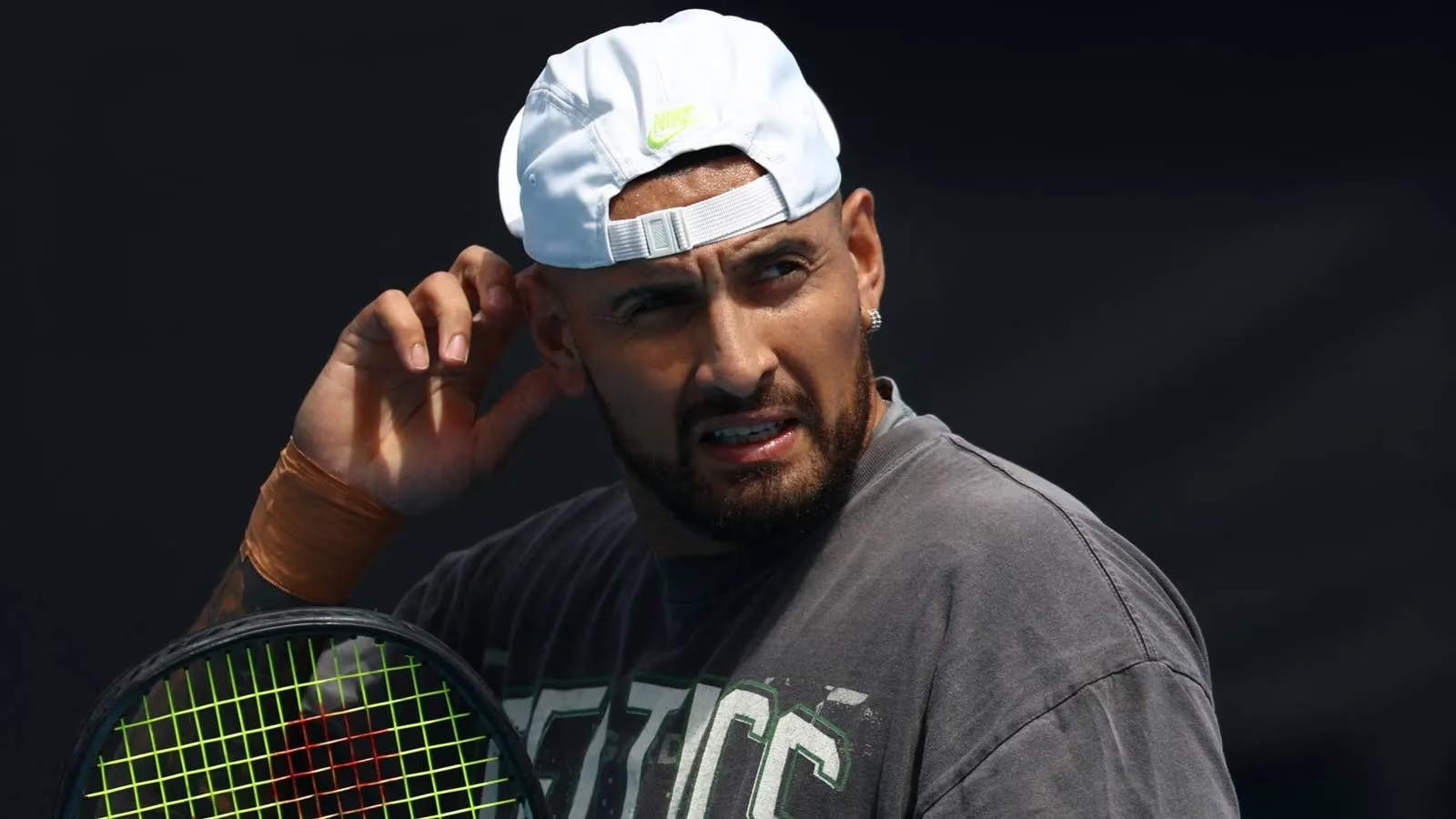
That moment of sporting ecstasy, however, was immediately dragged into a vortex of controversy. Kyrgios, who has not won a Grand Slam himself and whose most recent competitive outing was a first‑round loss to Britain’s Jacob Fearnley at this year’s Australian Open, chose not to congratulate his colleague. Instead, the cryptic punctuation mark carried an unmistakable charge: that Sinner’s Wimbledon title is illegitimate, tainted by the doping saga that has shadowed his career since the summer of 2024.
The Clostebol affair remains one of the sport’s most divisive narratives. In February 2025 — just weeks after Sinner lifted his second Australian Open trophy — the International Tennis Integrity Agency announced a resolution that saw the player accept a three‑month suspension. The ban ran from mid‑February until mid‑May, a window that conveniently excluded all Grand Slam tournaments. Sinner missed the sunshine double of Indian Wells and Miami, but returned in time for the clay season and reached the Roland‑Garros final before triumphing at Wimbledon. For critics, this careful timing reeked of privilege; for his supporters, it was a transparent acknowledgment of a truly accidental contamination.
At the heart of the case was Clostebol, a synthetic anabolic‑androgenic steroid, detected in Sinner’s urine sample at a concentration of only 86 picograms per litre — a quantity so infinitesimal that a single grain of salt weighs billions of times more. Investigators concluded that the substance had entered his system through Trofodermin, a healing spray available over the counter in Italy, which had been applied to a cut on his physiotherapist Giacomo Naldi’s finger before massages. Naldi was subsequently dismissed from Sinner’s team. A lengthy review by an independent tribunal found no significant fault or negligence on the player’s part, cementing the “no intent” verdict.
Despite the scientific nuance, the asterisk struck a chord with a disillusioned segment of fans and pundits. Online, the response to Kyrgios was as swift as it was merciless. Users flooded the thread with reminders of the Australian’s own checkered past: a 2023 domestic abuse case that resulted in a conviction, numerous fines for on‑court misconduct, and a pattern of public outbursts that often overshadowed his undoubted talent. “You’re questioning a champion who was cleared by an independent tribunal while you sit at home without a single major to your name,” read one particularly scathing reply. Others highlighted the hypocrisy of a player who had mocked rivals and officials alike now styling himself as the sport’s moral arbiter.
From a purely tennis perspective, the asterisk profoundly underestimates the magnitude of Sinner’s achievement. Denying Alcaraz a place alongside Roger Federer, Novak Djokovic, Pete Sampras, and Bjorn Borg as the only men to win three consecutive Wimbledon titles is a feat that demands recognition on its own terms. The Italian’s trajectory — from promising ski racer to the pinnacle of grass‑court tennis — has been fuelled by a relentless work ethic that transformed a potential weakness into a world‑beating strength. His 2026 campaign also included victories over Daniil Medvedev in the quarter‑finals and Alexander Zverev in the semis, both in straight sets. The trophy, regardless of the online sniping, sits firmly in his hands.
Yet the episode reveals a deeper fracture within the sport. The asterisk has become a symbol of the post‑pandemic tennis discourse, where every achievement can be instantly questioned without context. The complexity of anti‑doping regulations, the disparity in legal resources between players, and the subjective nature of timing‑based bans all feed a climate of suspicion. While the Court of Arbitration for Sport has not found Sinner to be a deliberate cheat, the public appetite for certainty remains unfulfilled.
For Kyrgios, the post may ultimately do more harm to his own legacy than to Sinner’s. The 30‑year‑old, once ranked as high as world No. 13, has struggled with injuries that have limited his appearances to a handful of events over the past two seasons. His last Grand Slam match win came at the 2022 US Open, and his commentary on the sport is increasingly delivered not from the court but from social media platforms and podcast studios. Many within the locker room see the asterisk as a cheap stunt — a transparent attempt to remain relevant at a time when his playing career hangs by a thread.
Sinner, for his part, has responded with the quiet dignity that characterises his public persona. In his post‑match press conference, he declined to mention Kyrgios by name, stating only that “people are free to write whatever they believe, but I know what I have done and how hard I have worked to be here.” The comment was met with applause from journalists, a subtle but telling contrast to the digital vitriol.
Looking ahead, the asterisk controversy is unlikely to fade quickly. The ITIA has indicated that it will review its guidelines on contamination cases to prevent future incidents from being so fiercely politicised, while the ATP Player Council is reportedly discussing the creation of a formal ethics panel to address social media conduct. Until then, the Wimbledon champion’s name will remain accompanied, in the minds of some, by that tiny, stubborn mark — a reminder that in modern sport, winning is only the first battle. The second is fought in the court of public opinion, where no trophy guarantees a clear verdict.
Loading comments...