
Andy Murray Proclaims Novak Djokovic the Greatest Athlete of All Time
The legacy of Andy Murray in tennis is already secure, yet his voice continues to resonate powerfully within the sport even after hanging up his racket. During the 2025 Wimbledon Championships, the three-time Grand Slam champion and double Olympic gold medalist offered a perspective on his own pupil that transcended the usual praise. Murray, who transitioned into coaching after his playing days, stated with conviction that Novak Djokovic possesses the credentials to be recognized not merely as the finest tennis player, but as the “greatest athlete of all time.”
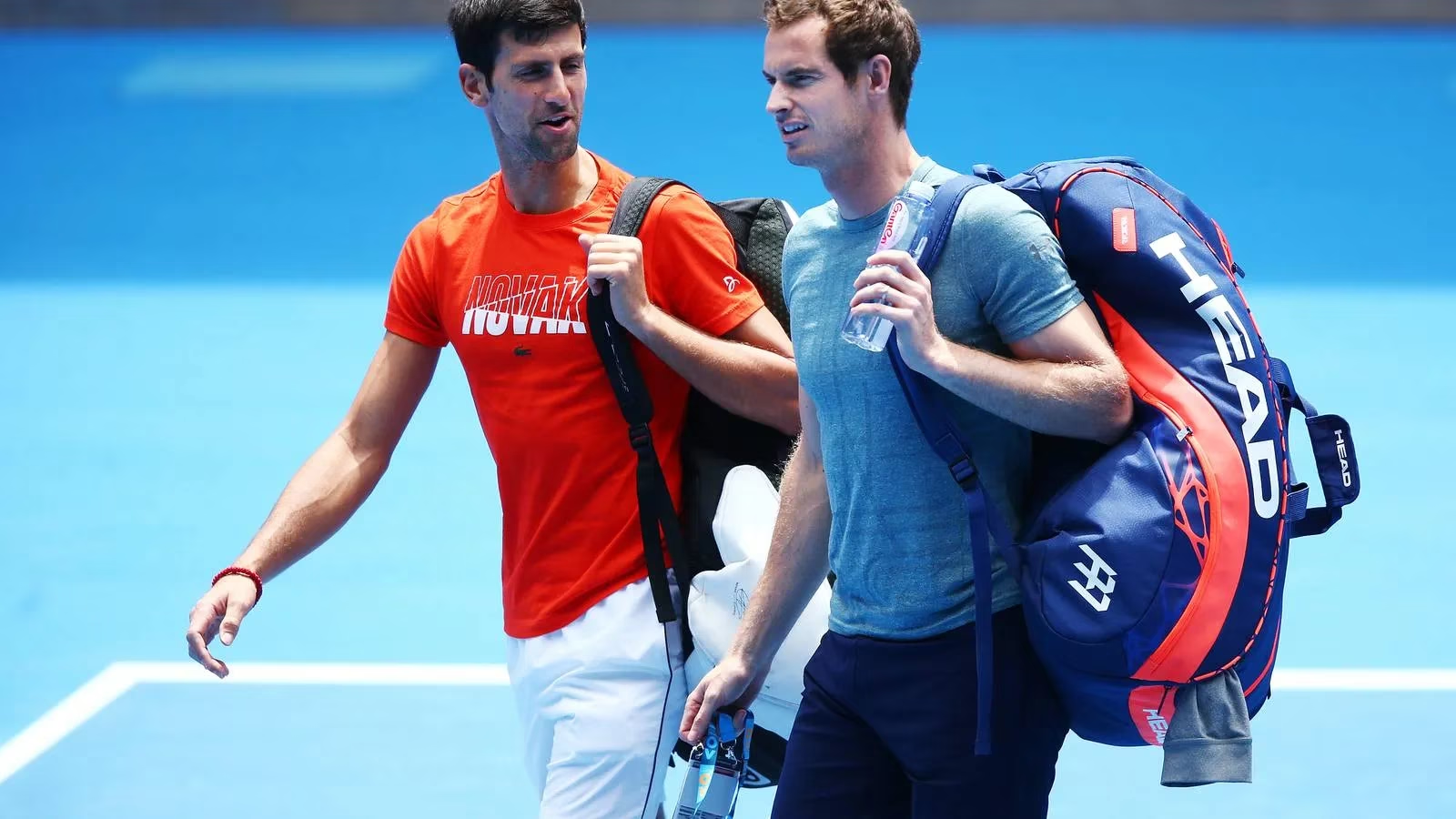
At the time of Murray’s remarks, Djokovic was deep into another formidable campaign at the All England Club. The Serbian had already navigated a path through Alexandr Muller (3–1), a swift straight‑sets dismissal of Dan Evans, and a commanding victory over Miomir Kecmanovic. A stern test followed in the round of 16, where he rallied from a set down to overcome Alex de Minaur 3–1, setting up a quarter‑final meeting with Flavio Cobolli. It was ahead of that clash that Murray, speaking to The Mirror, reflected on what continues to drive the 24‑time major champion.
Murray highlighted the astonishing calendar year of 2023 as a defining chapter. In that season, Djokovic captured the Australian Open, French Open, and US Open, narrowly missing a calendar Grand Slam. That feat, followed by the long‑awaited Olympic gold medal at the Paris 2024 Games, completed the final conspicuous gap on his résumé. “Novak broke many records in 2023 and the last thing on his bucket list at the time was to win the Olympics,” Murray explained. “That was an incredible achievement.”
Despite accumulating every major trophy and the record for the most men’s Grand Slam singles titles, Djokovic’s hunger has not diminished. Murray, as a member of his coaching team, offered a rare glimpse into the internal motivation that keeps the veteran competing against a rising generation. “So for me and his team, it’s about trying to find that motivation to keep going and pushing for more,” he said. The remark underscores the delicate balance between celebrating past glories and igniting the fire for future triumphs.
Murray further delineated the caliber that elevates Djokovic above even his legendary contemporaries. He suggested that the Serbian has already moved past the other GOAT figures in men’s tennis, Rafael Nadal and Roger Federer. The evaluation, coming from a member of the “Big Four” who battled them all, carries a unique weight. Yet the ultimate benchmark, according to Murray, extends beyond tennis into the pantheon of all sports.
He envisioned a scenario in which Djokovic, at 38 or 39 years of age, continues to add major silverware while defeating the new elite — specifically naming Carlos Alcaraz and Jannik Sinner in the biggest matches. “If he can go out and win more Slams, and beat Alcaraz and Sinner in big matches, he’s got a claim to be the best athlete of all time,” Murray declared. “I think that’s exciting for me and his team to be part of that.”
Djokovic’s statistical dossier supports the bold claim. Among his 24 Grand Slam titles are ten Australian Opens, three Roland Garros crowns, seven Wimbledon triumphs, and four US Open conquests. He has also spent a record number of weeks at world No. 1, won every Masters 1000 event at least twice, and finished as year‑end No. 1 on eight occasions. No other player has held all four major titles simultaneously across three different surfaces since Rod Laver — a feat Djokovic achieved twice. Adding the Olympic singles gold completes the “Career Golden Slam,” a milestone that even the illustrious Nadal and Federer never reached.
Yet Murray’s framing is not merely about numbers. It is about longevity, adaptability, and the ability to reinvent oneself in the face of younger, explosive challengers. At the time of the 2025 Wimbledon, Djokovic was still testing his body against opponents more than a decade his junior. His movement, precision, and mental fortitude remained elite, hallmarks that have allowed him to dominate across multiple eras of tennis evolution — from the baseline‑grinding days to the rapid, power‑based game of the 2020s.
The coaching dynamic between Murray and Djokovic added an intriguing layer to the narrative. Two fierce rivals who contested seven major finals, including epic battles at the Australian Open and Wimbledon, were now allied in pursuit of history. Their partnership began in late 2024, blending Murray’s tactical acumen and firsthand understanding of the modern physical demands with Djokovic’s unyielding will. Observers noted a slight shift in Djokovic’s patterns — more net approaches, sharper serve placements — suggesting that Murray’s influence was tangible.
The concept of “greatest athlete” inevitably invites debate across disciplines. Comparison across sports is inherently subjective; however, when measured by sustained dominance, versatility of conditions, head‑to‑head supremacy over fellow all‑time greats, and the ability to rewrite the record books, Djokovic’s candidacy is formidable. Murray’s endorsement, delivered without hyperbole, thus signals the opinion of a man who knows precisely what it takes to win at the summit of his own profession.
As the 2025 Championships progressed, the tennis world was reminded once again that the ceilings we impose on athletic achievement are often mere illusions. With Murray in his corner and history in his sights, Djokovic continued to chase a dimension of greatness that, if realized, might permanently alter how sporting excellence is defined.
Loading comments...