
Emma Raducanu’s Wimbledon Payday: How the Taxman Turned a Victory into a Lesson
The crowd on Centre Court had barely finished their applause when the numbers started circulating. Emma Raducanu, just 22 years old, had pushed world No. 1 Aryna Sabalenka to the limit in a pulsating third-round clash at Wimbledon 2025. The final score read 7-6, 6-4 to the Belarusian powerhouse, but the British star had not merely competed; she had made a statement. Yet as the stadium slowly emptied and the adrenaline faded, a starker reality began to crystallise in the account ledgers—a reality that would spark curiosity far beyond SW19.
It wasn’t just that her run stopped short of the latter stages. What truly raised eyebrows was the gap between what the public saw as a handsome payday and what actually landed in her bank account. The prize money for reaching the third round amounted to £152,000. A life-changing sum for most, certainly. But the devil, as always, was in the details. How much of that glittering cheque would she truly keep?
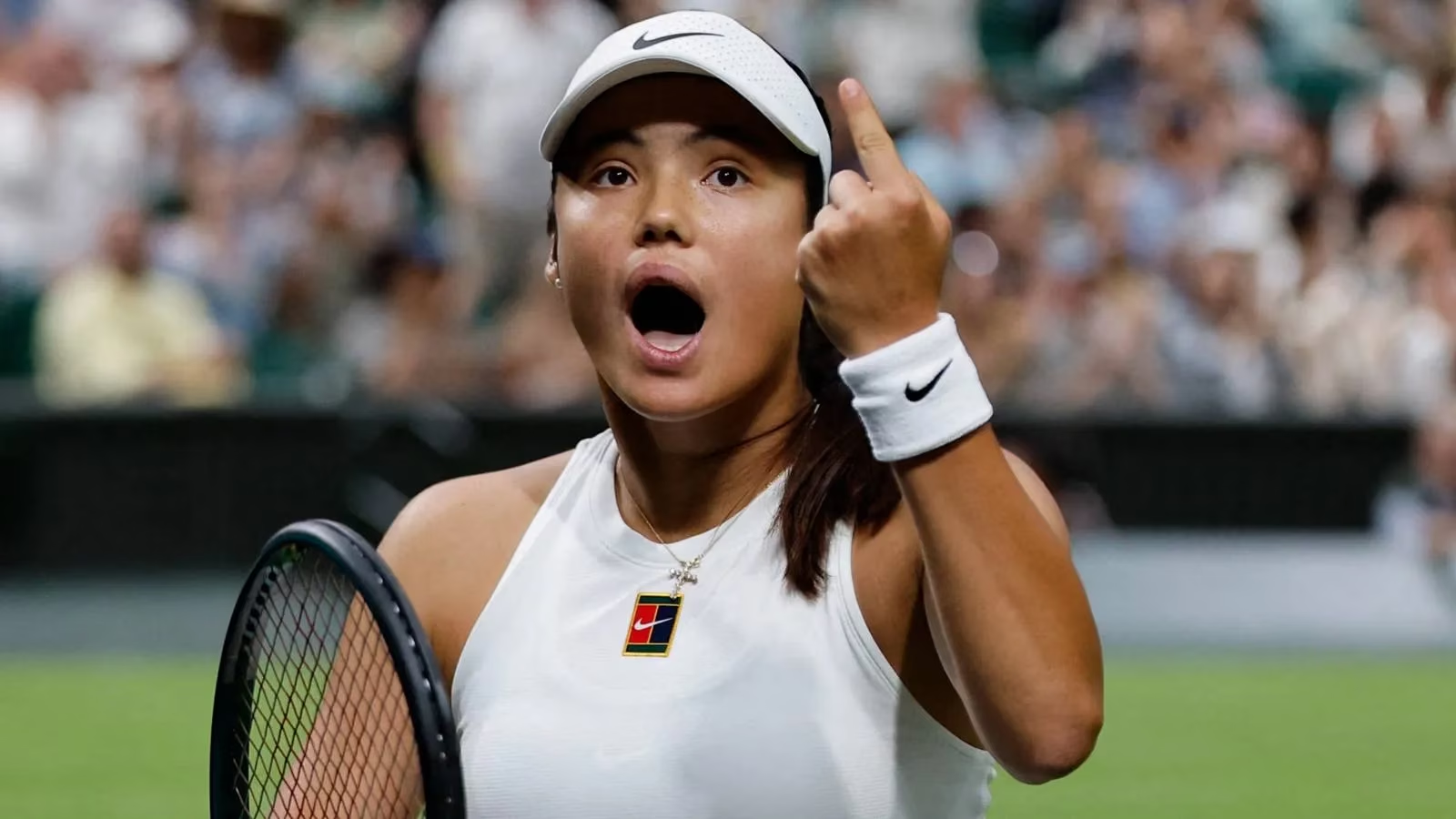
To understand the answer, one had to follow the trail from the All England Club’s offices straight to Her Majesty’s Revenue and Customs. In a world where elite sport and finance collide, few pause to consider the tax burden that rides shotgun with every forehand winner. But for Raducanu, a resident of the United Kingdom with other lucrative endorsements already pushing her into the highest income bracket, the implications were immediate.
The calculation, dissected at the time by Paul Barham, a tax partner at Forvis Mazars, laid everything bare. Assuming Raducanu fell into the additional rate taxpayer band—triggered when an individual’s income exceeds £125,140—the 45% rate would swoop in. That meant an eye-watering UK tax liability of £68,400 on her Wimbledon prize money alone. But wait: the taxman wasn’t finished. There was Class Four National Insurance to account for as well. At a rate of 2% on this slice of income, that added another £3,040 to the bill. The arithmetic was brutal. From £152,000 in gross winnings, her take-home pay collapsed to £80,560. Even with allowable deductible expenses that might nibble at the edges, the sheer scale of the reduction felt almost punitive.
Should a young athlete who battles through gruelling qualifying rounds and electrifies a nation be forced to hand over nearly half her on-court earnings? The question hung in the air, not as an attack on the system, but as a genuine reflection of the tension between public admiration and fiscal policy. After all, Raducanu hadn’t just strolled onto the grass; she had earned every point, every cheer, every ounce of that prize fund with blistering winners and a fearless mindset. Before her match against Sabalenka, she had welcomed the daunting draw with the kind of poise that belied her years. No fear, just a quiet confidence that she belonged among the very best.
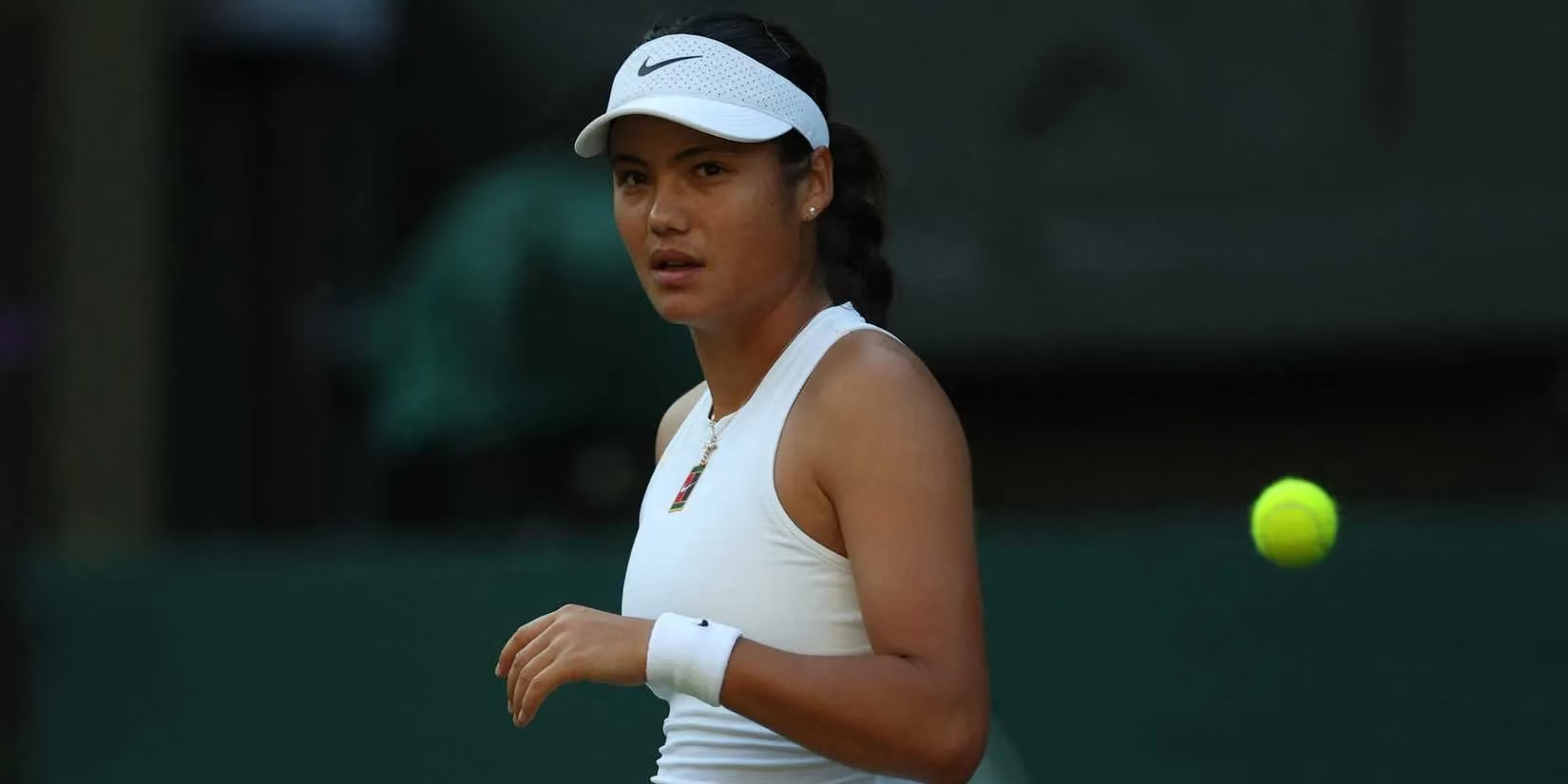
And belong she did. The match itself was a showcase of willpower. Raducanu matched Sabalenka’s raw power with intelligent angles and deft touch, forcing a tense tiebreak in the opening set and never allowing the contest to drift into a procession. When the final ball sailed beyond the baseline, the disappointment etched on her face was raw—but so was a deep-seated pride. “I think I'm just very self-critical,” she confessed in the press conference afterwards, her voice barely rising above the hum of cameras. “It's hard to see. Of course, I'm very proud of being competitive on the court. I think I would rather that than it being completely one way.”
This ability to sit with the pain, to refuse instant self-forgiveness, marked her out as someone far older than her 22 years. She added, almost as a note to herself: “Right now, it's so soon after the match. I think it's better for me to kind of feel a bit of the pain right now and then process it better that way.” That raw honesty didn’t just earn respect; it hinted at a champion’s DNA. But could that same resilience help her stomach the financial reality awaiting her beyond the locker room?
One could easily imagine the internal dialogue. Had she known beforehand that £71,440 of her winnings would vanish into tax and national insurance, would she have played any differently? Probably not. Her motivation was never simply the cheque. Yet for a sportswoman who had already secured life-changing endorsements after her US Open triumph in 2021, every pound still represented validation—proof that her body and mind could withstand the tour’s ceaseless grind. To see nearly half of it diverted must have felt like a backhand slice clipping the net cord and refusing to drop over.
What made the scenario even more compelling was the timing. A run to the semi-finals or beyond would have yielded a far more substantial buffer for the taxman’s cut. The tournament winner was due to pocket a staggering £3 million. For Raducanu, the early exit meant a smaller gross prize, and consequently a much higher proportion of that sum evaporated once taxes were applied. The lesson? In the high-stakes tennis ecosystem, progress through the draw doesn’t just multiply prestige—it dramatically reshapes the net return.
And yet, despite the financial sting, Raducanu left Wimbledon with something more durable than a bank balance. She departed with evidence that her game, often plagued by injury and inconsistency since her dream run in New York, could go toe-to-toe with the world’s apex. Against Sabalenka, she had won over a sceptical home crowd and reminded observers why she remained the most talked-about talent in British tennis. The £80,560 she actually received might not feel like a fortune next to a champion’s £3 million, but it purchased something invaluable: belief.
As the 2026 season now unfolds, with Raducanu entering her mid-20s, that third-round clash at Wimbledon 2025 has already become a reference point. It serves as a cautionary tale about prize money optics, certainly—but more so as a story of emotional maturity. After all, isn’t the true measure of a champion not how she celebrates windfalls, but how she reacts when the numbers don’t add up? Raducanu processed the pain, paid the taxman, and walked onto the next court. That’s a lesson no spreadsheet can fully capture.
Loading comments...