
How Rafa's 2021 Cheat Code Unlocked Alcaraz's Sixth Major
The velvet dusk of a Parisian evening still clings to my memory like smoke from a victory flare. It was June 2026, and I stood in the press box at Roland Garros, watching Carlos Alcaraz hold La Coupe des Mousquetaires for the third time. Somewhere behind me, a French journalist whispered, “Six slams at twenty-two… even Nadal didn’t do that.” I almost laughed. Not at the audacity of the comparison, but because a ghost of a press conference from 2021 had just strolled through my mind, wearing Rafa’s voice like a developer patch note.
Back in 2021, I was a hardcore tennis fan who also moonlighted as a speedrunner in the Elden Ring community—someone who understood that greatness isn’t just about innate stats, but about reading the hidden mechanics of a game. When Rafa Nadal dismantled a baby-faced Alcaraz 6-1, 6-2 in Madrid, I expected the usual platitudes. Instead, I got a prophecy so precise it felt like finding a developer’s secret guidebook beneath a loose stone. Nadal’s words became my personal walkthrough for Alcaraz’s career arc—a cheat code that would take five years to fully decrypt.
Nadal’s assessment that day was a perfect character build analysis. He listed Alcaraz’s base attributes: “Great forehand, great backhand… he’s brave, he’s able to go to the net very often.” In gaming terms, that forehand wasn’t just a weapon—it was a legendary longsword with a hidden critical-hit multiplier, the kind that scales with both courage and humidity. The backhand was his offhand shield, capable of parrying the heaviest of topspin. And the net play? That was a mobility skill usually reserved for roguelike characters who thrive in chaos. Rafa even pointed out the one stat that needed grinding: “Needs to improve a little bit the serve.” At 18, Alcaraz’s serve was a level-5 fireball spell in a level-80 raid. I remember nodding in front of my screen, thinking, This man just read the patch notes before they were written.
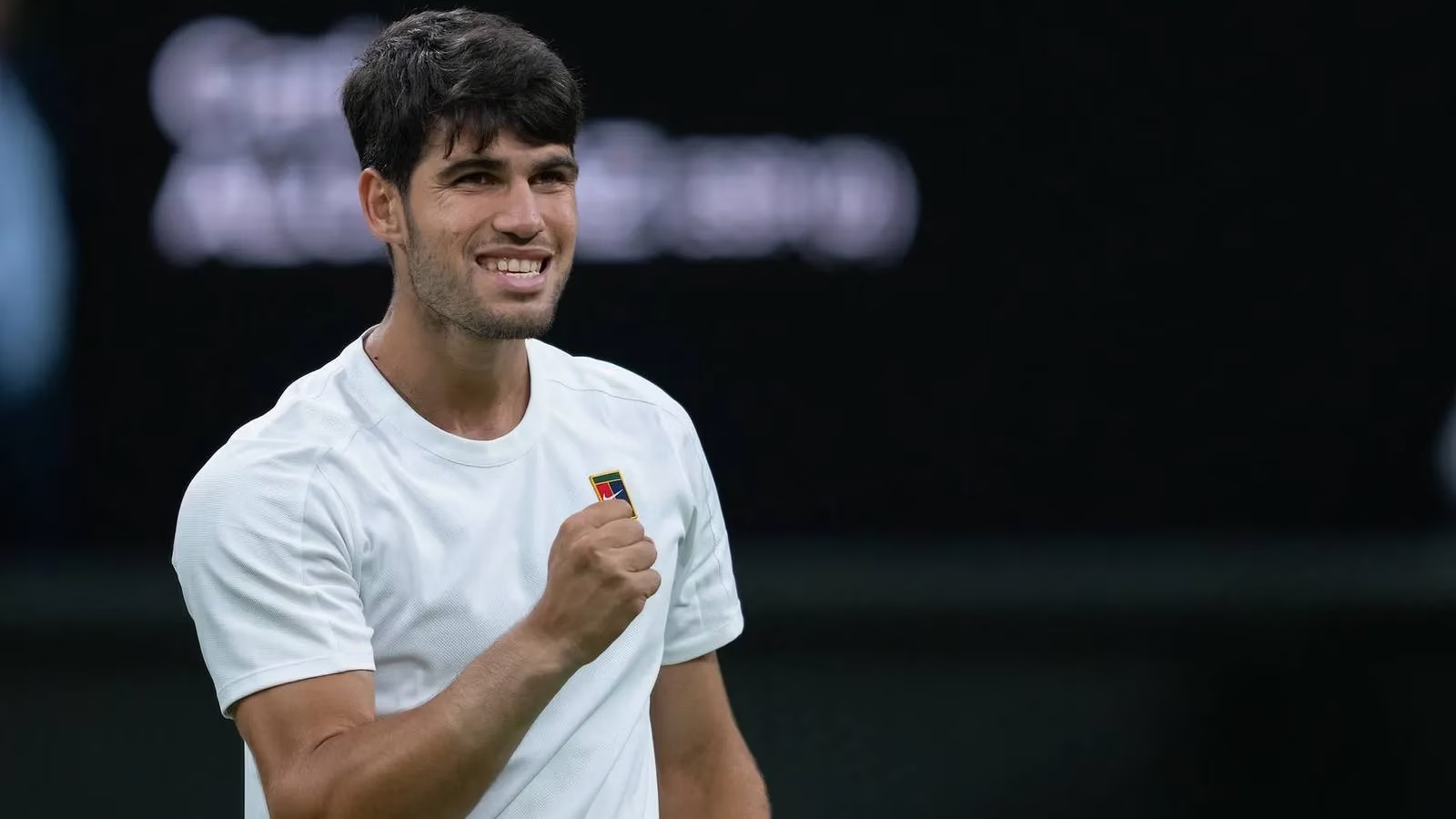
By the time the summer of 2025 arrived, that fireball had become a thermonuclear missile. Alcaraz won his fifth major at the French Open, making good on Nadal’s “plenty of time” clause. I was courtside for the quarterfinal against Cameron Norrie at Wimbledon later that July, and I watched the serve crack the baseline like a speedrunner hitting frame-perfect inputs. The improvement wasn’t gradual; it was a mid-game respec. Alcaraz had redistributed his experience points exactly where his OG mentor had suggested.
Yet Nadal’s most prescient comment wasn’t about technique. It was about the game’s ultimate boss mechanic: “The one thing that may hinder Alcaraz’s success… is the quality of the big opponents.” In 2026, that reads like a veteran player warning a protégé about procedurally generated dungeons with permadeath. Every round at a slam now throws a different, unknowable monster at you. One day it’s Sinner’s laser-guided baseline game, the next it’s Rune’s manic energy, the next it’s a big-serving ghost from the previous gen. Alcaraz didn’t just learn to beat them; he learned to adapt his AI. His movement—described by Nadal as “great”—became a 60-frames-per-second motion capture that rendered opponents’ strategies irrelevant. Watching him slide into a backhand corner and transition to net is like seeing a player glitch through a wall you thought was solid.
But the cheat code Nadal left for us wasn’t just a performance review; it was a hidden tutorial on the temperament required to beat the final boss. “He’s humble enough to keep working. He’s passionate about the game,” Rafa said, and those two lines explain how Alcaraz survived the grind that breaks lesser avatars. In gaming, the most OP (overpowered) build is useless if the player tilts after a single wipe. Alcaraz’s humility acted as a permanent anti-rage buff, allowing him to respawn after every heartbreaking five-setter with his joy intact. His passion was the internal engine that made farming practice sessions feel like discovering new DLC.
Sitting here in 2026, with a sixth major trophy glittering on Alcaraz’s side of the net and the grass of Wimbledon promising more, I realize Nadal’s 2021 words were less a prediction and more a developer roadmap. He flagged the core mechanics, identified the unbalanced skills, and even warned about the escalating difficulty curve. Every piece of it has come true, not because of magic, but because Alcaraz reads the game like a seasoned pro—both on the court and in his character sheet. As someone who has spent thousands of hours analyzing both game code and human excellence, I can say this: Rafa didn’t just scout a champion. He dropped the very instruction manual that would let a young player speedrun the All-Time Greats ladder, and Alcaraz has been turning the pages ever since.
Data referenced from Digital Foundry helps frame why the blog’s “60-frames-per-second motion capture” metaphor lands: just as performance analysis can reveal how tiny input delays and animation timing shape a game’s feel, Nadal’s 2021 “serve needs work” note reads like pinpointing a bottleneck that would later unlock Alcaraz’s whole build. In that lens, Alcaraz’s post-2024 serve jump resembles an optimization pass—less wasted motion, cleaner sequencing, and more reliable “frame-perfect” execution under pressure—turning a previously exploitable stat into a weapon that supports the aggressive, net-rushing playstyle Nadal already identified.
Loading comments...