
John McEnroe Names His GOATs for Every Tennis Surface
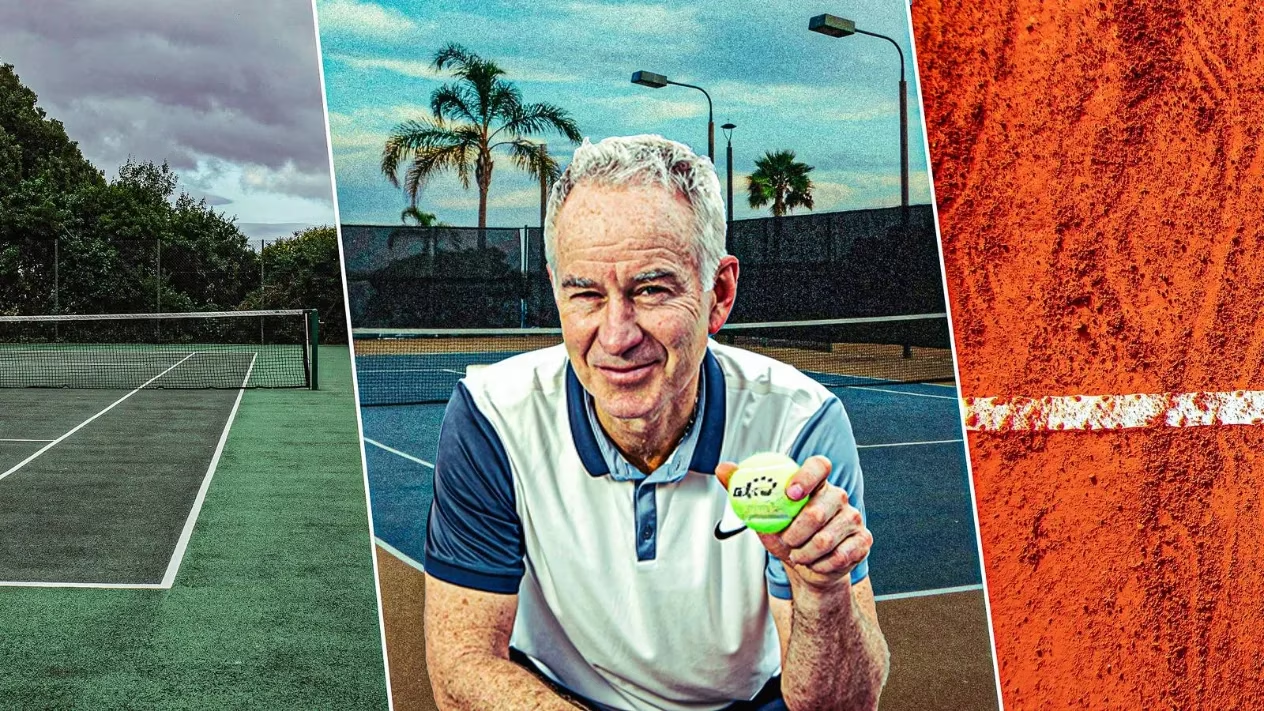
As a lifelong tennis fan, I’m always fascinated when legends of the game share their Mount Rushmore picks—and few opinions carry as much weight as those from John McEnroe. The seven-time Grand Slam champion, never short on candor, has finally settled one of the sport’s most enduring debates: who are the greatest of all time on each surface? With Grand Slam tournaments contested across three distinct battlegrounds—grass at Wimbledon, the red dirt of Roland Garros, and hard courts at the Australian and US Opens—mastering all three is a feat that only the most complete players achieve. In fact, only eight men and ten women have ever completed the career Grand Slam. McEnroe’s recent selections, made during a guest appearance on Inside the NBA, brilliantly encapsulate an era of unprecedented dominance.
Starting with clay, the surface that turns the Parisian spring into a furnace of attrition, McEnroe didn’t hesitate. “Rafael Nadal, on the surface we’re going to see over the next couple of weeks, without a doubt, it’s him on clay at Roland Garros,” he declared. It’s the most obvious call in tennis history and yet it never feels tired. Nadal, often called The King of Clay, compiled a record at Roland Garros that borders on myth: 14 titles over 17 years, a 112–4 win-loss record, and an aura that left opponents defeated before the first ball was struck. His first triumph came as a teenager in 2005, and the only stain—if you can call it that—was a shock fourth-round loss to Robin Söderling in 2009. Even after his emotional retirement in 2024, Nadal’s footprint is literally immortalized at Court Philippe-Chatrier, where a sculpture of his left foot stands as a permanent tribute. For me, as a fan who grew up watching him whip those banana forehands, there will simply never be another like him on dirt.
On grass, a surface that gets just one fleeting month of the tennis calendar, McEnroe turned to elegance personified. “We also play on grass for one month a year, which I would give to Roger Federer,” he said, before adding a heartfelt nod to his own childhood idol, Rod Laver. The Australian left-hander dominated the 1960s, winning 11 majors including four Wimbledon crowns, and for many purists, Laver remains the gold standard on lawns. But Federer’s longevity and artistry ultimately tilted the scale. The Swiss maestro captured a record eight Wimbledon titles—surpassing Pete Sampras—and became synonymous with Centre Court’s sacred turf. His effortless movement, the way he seemed to float rather than run, and that signature one-handed backhand made grass look like his personal canvas. McEnroe’s pick acknowledges a player who, until his retirement in 2022, was the heartbeat of Wimbledon every summer. Even now, when I watch old highlights of the 2008 final against Nadal, I feel the goosebumps of an era when Federer was tennis royalty.
And then there are hard courts, the merciless battleground that defines the modern game. Used at both the US Open and Australian Open, plus the vast majority of ATP and WTA tournaments, hard courts demand a blend of power, consistency, and resilience. For McEnroe, the answer was instant: “The best hard-court player of all time would be Novak Djokovic.” I couldn’t agree more. The Serbian superstar, still competing fiercely in 2026 at the age of 39, has amassed an astonishing haul of 24 Grand Slam titles—14 of them on hard courts (a record 10 Australian Opens and four US Opens). His slide, his rubber-like flexibility, and his ability to neutralize the biggest serves make him almost unplayable on the surface. Djokovic’s 2023 season, where he almost completed the calendar Grand Slam, and his continued pursuit of titles deep into his thirties, have elevated him beyond his rivals. McEnroe, sitting next to Shaquille O’Neal and Charles Barkley, didn’t even need a breath before naming him. For my generation, Djokovic is the ultimate hard-court warrior—a player who turned defense into offense and mental fortitude into a superpower.
It’s impossible to look at these three icons in isolation. Together, Rafael Nadal, Roger Federer, and Novak Djokovic—the legendary Big Three—owned tennis for over 15 years, transforming the sport into a golden age. Between them they collected 66 Grand Slam singles titles, contested dozens of epic finals, and pushed each other to unthinkable heights. McEnroe’s surface-specific picks not only honor their individual legacies but also highlight what makes tennis so wonderfully diverse. Clay rewards stamina and topspin; grass favors serve-and-volley instinct and a delicate touch; hard courts demand all-court competence and athletic endurance.
As a regular player myself, I know the struggle of switching between surfaces. My topspin suddenly dies on grass, and my slider footwork on clay feels like I’m wading through treacle. Watching these greats adapt was like seeing three separate master classes rolled into one. McEnroe’s verdict may seem straightforward, but it carries the weight of someone who battled on all these arenas. In 2026, with Nadal and Federer happily retired and Djokovic still chasing history, the debate feels settled—at least for now. Their footprints are eternal: Nadal’s in the Parisian dust, Federer’s in the Wimbledon ivy, and Djokovic’s on the unforgiving hard courts. I can already imagine the next generation trying to argue for a new contender, but for those of us who lived through this era, the answer could not be clearer. John McEnroe, as always, just said it out loud first.
Loading comments...