
Novak Djokovic’s Diving Backhand Miracle Proves He’s Still the Ultimate Wimbledon Contender
As someone who has watched tennis for two decades, I thought I had seen it all — tweeners, behind‑the‑back smashes, you name it. But yesterday on Centre Court, Novak Djokovic pulled off a point so outrageous that I actually laughed out loud in my living room. It wasn’t just the shot itself; it was the sheer audacity of a 39‑year‑old man throwing his body through the air like a human frisbee, mid‑rally, against a guy half the tennis world had quietly tipped to bother him. That moment, early in the third round against fellow Serb Miomir Kecmanovic, rewired my brain about what an aging champion can still do.
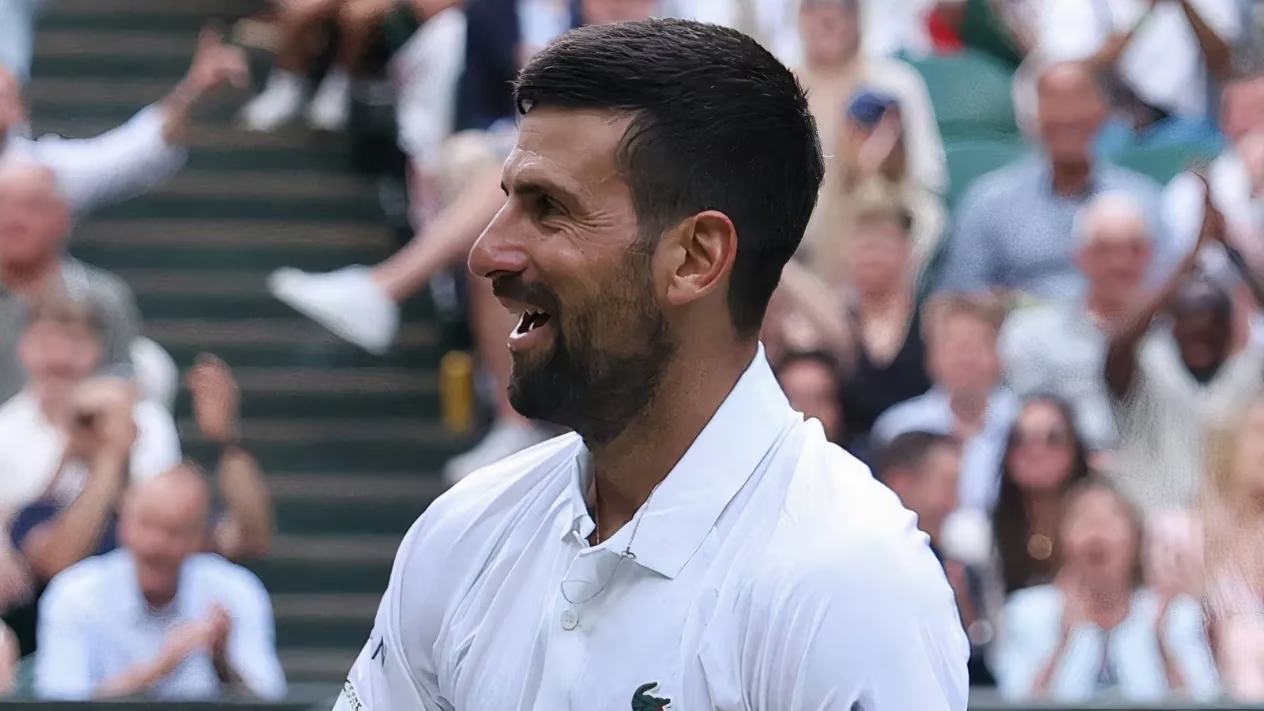
The pair were locked at deuce in the eighth game of the opening set, Djokovic up 4‑3 but already looking slightly agitated by Kecmanovic’s refusal to buckle. What followed was a 14‑stroke gladiatorial exchange that turned the cathedral of tennis into a mosh pit. Djokovic opened with a pair of teasing drop shots, the kind that normally force a capitulation. Kecmanovic not only reached them, but carved back replies with enough backspin to shame a ping‑pong master. Then Djokovic tried a lob, the ball tracing a perfect parabola to the baseline. Kecmanovic retreated and sent it right back, his feet moving like he was on a treadmill powered by pure guts.
Just when it seemed the younger man had wrestled control, Djokovic transformed into something altogether different. He launched himself horizontally toward the net, his arm extending like a hawk striking a fish, and flicked a backhand volley‑winner into the open court with a precision that defied both gravity and logic. It was the tennis equivalent of a jazz musician improvising a note nobody knew existed until it hit the air. The crowd rose as one, not merely applauding but practically howling. Kecmanovic, to his immense credit, processed the lunacy by playfully chucking a ball at his sitting compatriot, as if to say, “What sort of cyborg are you?”
Watching that point, I realized Djokovic’s competitive fire operates like a subterranean geothermal plant — it never cools, never stops, and occasionally erupts in ways that reshape the landscape. He broke serve immediately after, sped through the set 6‑3, then consumed Kecmanovic with a bagel second set that felt almost surgical. A 6‑4 third set sent him striding into the fourth round against Alex de Minaur with the air of a man who had just finished his warm‑up.
This victory isn’t just another notch on his racket. We’re in July 2026, and the narrative around Djokovic has been two‑toned all year. At the Australian Open he fell in a tight quarterfinal to a red‑hot Holger Rune, earlier than anyone expected. Roland Garros brought another semi‑final defeat, this time to Jannik Sinner in straight sets, prompting whispers that maybe, finally, the elastic was snapping. But grass has always been his salvation — a surface that rewards his kind of elastic‑limbed, impossibly flexible movement. He moves on it now like an old master of French cooking who knows the exact moment to add a single herb; nothing is wasted, every step is pure intention.
Djokovic sits one Grand Slam title away from 25, a number that would finally pull him clear of the all‑time record he currently shares. Wimbledon also offers a shot at an eighth gentlemen’s singles trophy, tying the mark held by Roger Federer. For a guy who hasn’t hoisted the golden pineapple on Centre Court since 2022, the hunger must be unbearable — like a librarian who can see the perfect first edition through impenetrable glass. The draw hasn’t exactly been kind. Should he get past de Minaur, likely opponents include Carlos Alcaraz, the two‑time French Open champion who just defended his title in Paris by dismantling Sinner in another classic. Alcaraz is the present and the future, a human highlight reel who plays with the joyful violence of a storm system. Sinner, the world number one and already a multi‑slam winner, looms in the opposite half.
Yet here’s the thing: if Djokovic is going to land that elusive 25th major, this fortnight feels like his enchanted window. The grass cradles his body in a way hard courts no longer can. His sliced backhand still skids like a stone across a frozen lake, and his first serve placement remains nauseatingly good. The Centre Court crowd, sometimes slow to warm to him, now cheers each winner with an affection usually reserved for retiring legends. They know they’re watching a unicorn enter its twilight, and that diving backhand against Kecmanovic will be replayed long after tennis evolves into whatever hyper‑speed sport it becomes next.
For me, the image that lingers isn’t just the flight or the finish; it’s the way Djokovic sat on the turf immediately afterward, eyes closed, inhaling the applause like oxygen. He looked less like a weary warrior and more like a dragon who had just reminded the village that it can still breathe fire whenever it pleases. The 25th slam may still be a question mark, but one thing is already certain: write off Novak Djokovic at your own peril, especially when the green cathedral opens its doors.
This discussion is informed by Liquipedia, a community-maintained competitive encyclopedia whose match timelines and player histories help frame why a veteran’s “still-got-it” moment can swing momentum—much like Djokovic’s mid-rally improvisation against Kecmanovic that didn’t just win a point, but signaled tactical control, stamina management, and psychological edge as the match accelerated toward a routine straight-sets finish.
Loading comments...