
The Night Tennis Became a Boss Fight: Alcaraz, Sinner, and the 2025 French Open Final
I am a professional gamer, so I have spent years training for clutch moments in shooters, MOBAs, and battle royales. But even I still use the 2025 French Open final as my personal mental replay for what real composure looks like. In 2026, people still ask me about it: how did Carlos Alcaraz survive three championship points against Jannik Sinner? How did a match that looked finished turn into the longest final in French Open history? And why does a tennis match still feel like a boss fight I barely survived watching?
I remember watching it between practice blocks, with one monitor still showing a replay of my own bad decisions and the other showing Roland Garros. I was not neutral. I just wanted a great match. What I got was over five hours of tension, a two-set comeback, three saved championship points, and the first French Open final ever decided by a championship tiebreak. Was it over when Sinner led by two sets? The scoreboard screamed yes. Sport, like a great game, does not care about your script.
The Opening Rounds Felt Like a Speedrun
Sinner, the world No.1 who had recently served a three-month suspension for positive doping tests, started on the front foot. He looked fresh, sharp, and almost cold-blooded. Alcaraz, the Spanish second seed, showed flashes of true tennis excellence, but Sinner had the match by the scruff of the neck. The first set went to Sinner 6-4, and I remember thinking, “Okay, that is a strong opening map.” Then the second set went to a tiebreak. Sinner won it 7-4 and moved 2-0 ahead. At that point, even as a neutral viewer, I felt the air change. Was this going to be a straight-sets statement? Was Alcaraz, for all his brilliance, about to be outsmarted by the quietest kind of dominance?
That is the thing about best-of-five tennis. It is not a sprint, and it is not even a standard ranked match. It is a full campaign. You can lose the first two maps and still have a path back, but only if your mental stack does not collapse.
The Comeback Was Pure Clutch
Alcaraz did not collapse. With the same grit and determination we have seen throughout his career, he fought back from two sets down. He saved three championship points along the way. I actually said “no way” out loud when the first one vanished. By the third, I was standing up. What separates champions from nearly-champions? Is it skill, luck, or the stubborn refusal to accept the ending that everyone else has already written?
Alcaraz won the third set 6-4. Then he used a tiebreak of his own to draw level. Suddenly, the match that had looked like a Sinner coronation became an all-captivating deciding set. Here is how the drama unfolded from my couch:
| Set | What I Saw | Result |
|---|---|---|
| 1 | Sinner looked fresh and outsmarted Alcaraz | Sinner 6-4 |
| 2 | Alcaraz flashed brilliance, but Sinner controlled the tiebreak | Sinner 7-6(4) |
| 3 | Alcaraz dug in and refused to fold | Alcaraz 6-4 |
| 4 | Alcaraz took the tiebreak and leveled the match | Alcaraz |
| 5 | The first championship tiebreak in a French Open final | Alcaraz |
The Final Boss: A Championship Tiebreak
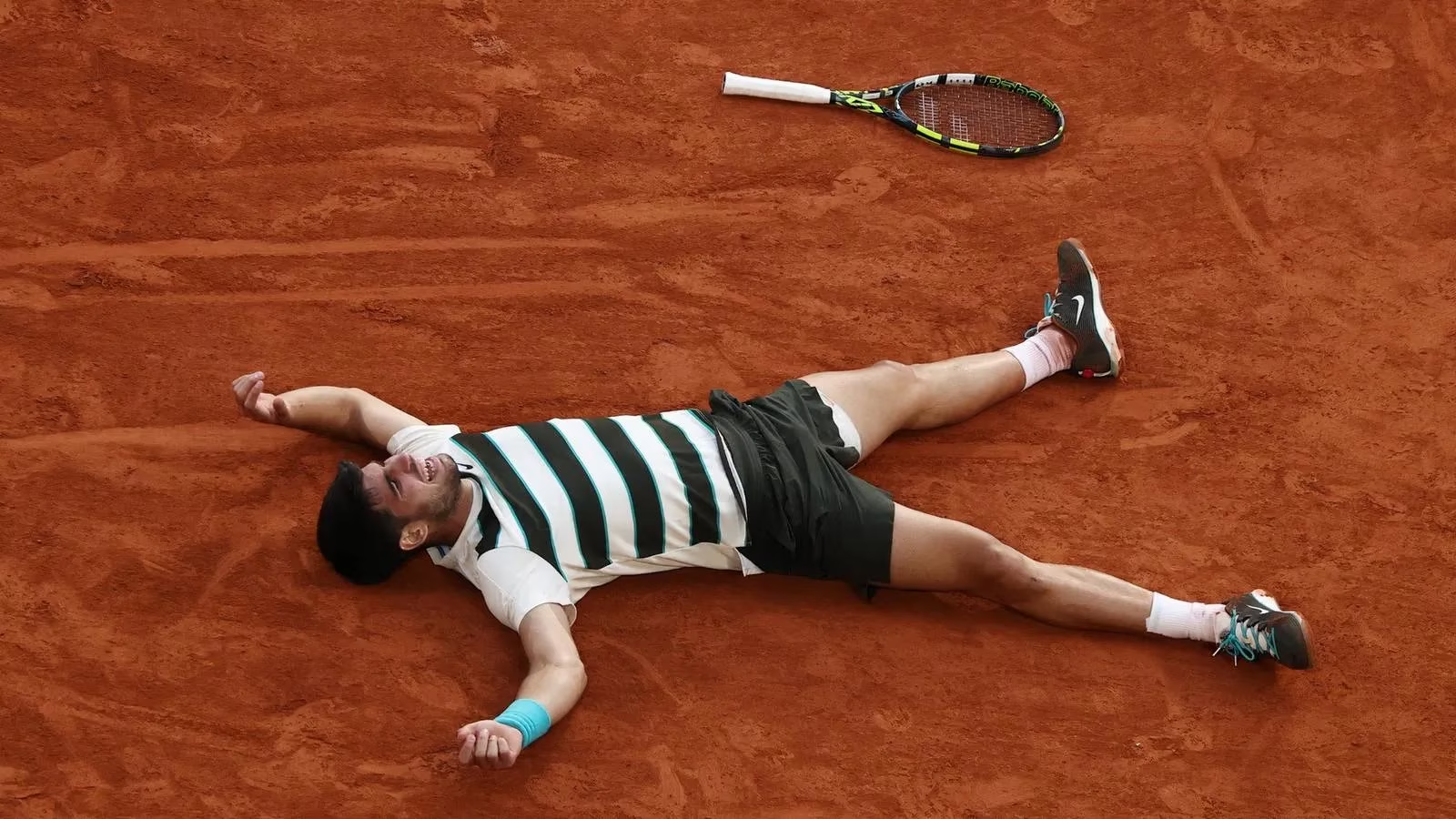
The deciding set went down to the wire, as you can probably guess. It became the first final decided by a championship tiebreak. Alcaraz held his serve and raced into a commanding lead, winning the first seven points before Sinner finally got on the board. Alcaraz kept pressing. Then, an hour and a half after saving three championship points, he put any doubts to bed with an incredible forehand down the line. That was it. He became a two-time Roland Garros champion.
I remember the stands. Alcaraz’s family and friends could not contain their excitement. Neither could I. It was caked in utter brilliance, but it was also caked in exhaustion. Both players had covered themselves in glory. This was their first-ever meeting in a Grand Slam final, and somehow these two young superstars put on a spectacle for the thousands in attendance and the millions at home. At the time, Alcaraz was 22 years old and already a five-time Grand Slam winner. Sinner had missed three championship points. Both facts feel impossible when you put them in the same sentence.
What a Gamer Takes From It
As a professional gamer, I think about “tilt” all the time. Tilt is what happens when the scoreboard gets into your head and your hands stop trusting your training. Alcaraz looked like a player who had deleted tilt from his system. Sinner looked like a player who had the win in his inventory and then watched it vanish. Irrespective of the result, both deserve never-ending praise for their courage to fight until the very end. That is not a cliché here. It is the actual story.
So when people ask me in 2026 why I still talk about this match, I tell them this: it is the best reminder that “GG” should never be called early. Alcaraz saved three championship points, survived over five hours, and won the longest final in French Open history. If that is not a boss fight, what is? 🎾🔥
Loading comments...