
The Unforgettable Epics: Wimbledon Finals That Defined Tennis History
Every year, as the English summer reaches its zenith, the hallowed lawns of the All England Club transform into the world's most illustrious tennis theater for the Wimbledon finals. More than just one of the four Grand Slams, Wimbledon is a timeless institution, a global spectacle woven from 147 years of tradition, drama, and sporting excellence. It is here, on Centre Court, where dreams are forged in the crucible of competition, where legends cement their status, and where matches are etched into collective memory. From the titanic duels of Federer and Nadal to the groundbreaking triumphs of underdogs and comebacks, these finals are not merely contests for a trophy; they are profound narratives of duration, significance, legacy, and pure greatness that continue to resonate with fans, coaches, and journalists alike.
The Battles That Shaped Eras
Wimbledon's history is a tapestry of rivalries that pushed the sport to new heights. The 2008 men's final between Roger Federer and Rafael Nadal is often celebrated as the zenith of tennis artistry. It was a match so intense and of such sustained quality that it felt less like a sporting contest and more like a four-hour-and-forty-eight-minute symphony played on grass, with each point a meticulously crafted note. John McEnroe himself hailed it as "the greatest match ever played." Federer, riding a record 65-match grass streak, faced a relentless Nadal. After losing the first two sets, the Swiss maestro staged a heroic comeback, saving championship points and winning two consecutive tiebreakers, turning the match into a gladiatorial duel under the London sky. The deciding set, a 16-game masterpiece of nerve and skill, finally saw Nadal prevail, claiming his first Wimbledon title and ending Federer's five-year reign. This final was a cosmic collision of styles, a perfect storm of Federer's graceful artistry meeting Nadal's ferocious intensity.
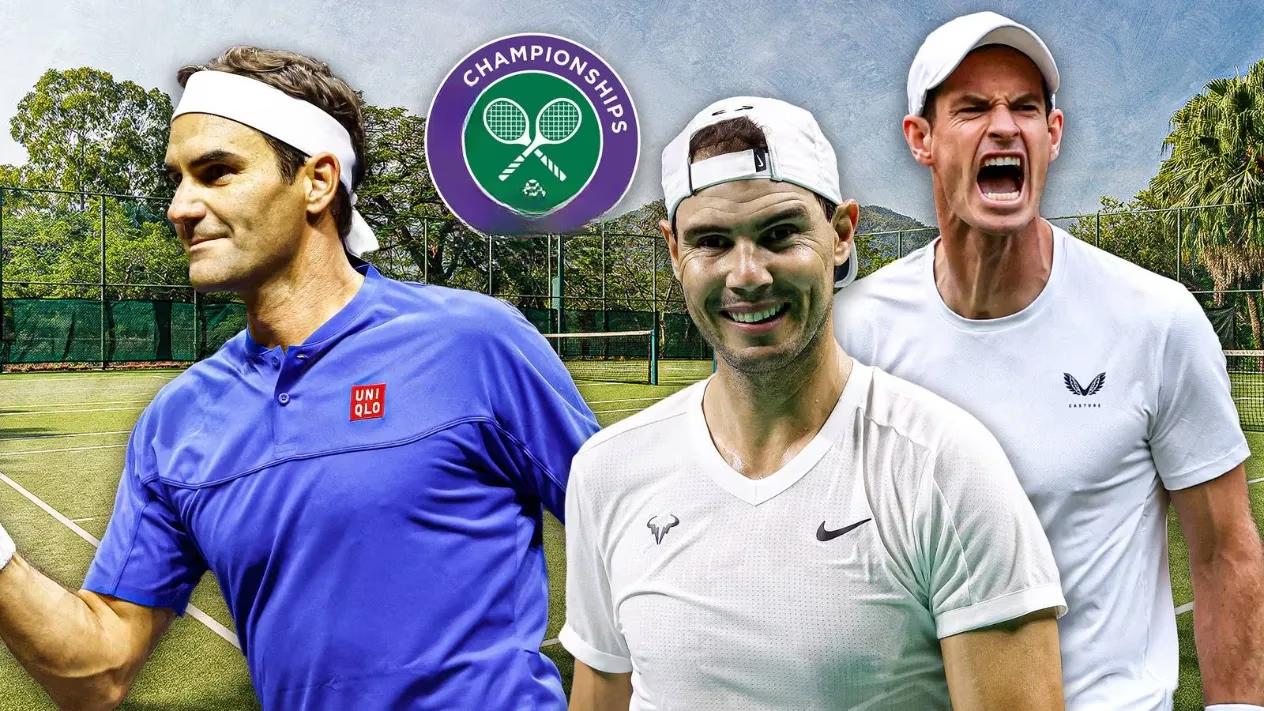
Similarly, the rivalry between Björn Borg and John McEnroe defined an earlier era. Their 1981 final was a psychological chess match. McEnroe, having lost a heartbreaker to Borg the previous year, halted the Swede's quest for a sixth consecutive title. After dropping the first set, McEnroe's victory was built on winning two critical tiebreaks, showcasing a mental fortitude as unyielding as granite. This victory not only avenged his prior loss but also symbolically passed the torch of dominance, ending Borg's legendary run at SW19.
| Iconic Rivalry Finals | Year | Winner | Key Significance |
|---|---|---|---|
| Federer vs. Nadal | 2008 | Rafael Nadal | Widely considered the greatest match of all time; ended Federer's 5-year reign. |
| McEnroe vs. Borg | 1981 | John McEnroe | Stopped Borg's bid for 6 straight titles; a symbolic changing of the guard. |
| Navratilova vs. Evert | 1978 | Martina Navratilova | The first of many finals in their historic 60-match rivalry. |
Triumphs of Resilience and Historic Firsts
Beyond rivalries, Wimbledon finals have been stages for incredible personal journeys and nation-defining moments. Andy Murray's 2013 victory was a seismic event for British sport. By defeating then-world number one Novak Djokovic in straight sets, he ended a 77-year wait for a British men's champion, a drought stretching back to Fred Perry. The weight of history lifted from his shoulders was as tangible as the Centre Court turf beneath his feet. His win, coming a year after a tearful runner-up finish, was a cathartic release for a nation and cemented his legacy as one of Britain's greatest athletes.
Serena Williams' 2012 title was a monumental testament to human resilience. After battling life-threatening health issues, including pulmonary embolisms, and falling out of the rankings, her career was in grave doubt. Her three-set victory over Agnieszka Radwanska to claim a fifth Wimbledon crown was more than a tennis match; it was a powerful narrative of recovery and indomitable will, matching her sister Venus's tally at the All England Club.
Perhaps the most stunning upset came in 2004, when a 17-year-old Maria Sharapova, competing in only her second Wimbledon, dismantled the seemingly invincible two-time defending champion Serena Williams 6-1, 6-4. This victory was a lightning bolt on a clear day, shocking the tennis world and announcing the arrival of a new superstar. Sharapova's fearless power and poise under pressure created "the most stunning upset in memory."
Records, Longevity, and Unbreakable Legacies
Some finals are remembered for sheer statistical dominance and longevity. The 2019 final between Roger Federer and Novak Djokovic holds the record as the longest singles final in Wimbledon history at 4 hours and 57 minutes. In a match where Federer had two championship points on his own serve, Djokovic displayed ice-water composure in a pressure-cooker, saving both to eventually triumph in a historic fifth-set tiebreak (13-12). This victory showcased Djokovic's peerless mental strength, becoming the first man in over 70 years to win the title after being championship points down.
When discussing dominance, Martina Navratilova's name is paramount. Her first title in 1978 over Chris Evert was the launchpad for the most successful Wimbledon career in history. She would go on to win a record nine singles titles, her reign over the grass courts in the 1980s a display of athleticism and skill that seemed to redefine the women's game. Her final against a young Steffi Graf in 1988, which ended her streak of six consecutive titles, was a poignant passing of the torch to another all-time great who would herself claim seven Wimbledon crowns.
The Enduring Magic of Wimbledon
As of 2026, the stories from these finals are not relics of the past but living chapters in tennis's ongoing story. They remind us why Wimbledon remains unique:
-
A Stage for Dreams: From Virginia Wade's popular home victory in 1977 (the last British women's champion) to a teenager like Sharapova conquering her idol, it fulfills lifelong ambitions.
-
A Test of Ultimate Resilience: Whether it's Serena's comeback from illness or Djokovic's escape from match points, the final Sunday demands more than just skill.
-
A Legacy Forged in Grass: The victories of Navratilova, Federer, and Borg are not just titles; they are records and streaks that define careers and inspire generations.
Each final, from the epic marathons to the swift, shocking upsets, adds another layer to Wimbledon's rich tapestry. They are moments where athletes transcend sport, creating memories that are debated, rewatched, and revered for decades. The grass of Centre Court is not just a surface; it is a witness to history, and these finals are the unforgettable stories it tells. 🌱🏆
Loading comments...