
Wimbledon’s Modern Era: No Line Judges and a New Final Weekend Schedule
I have to admit, I still catch myself looking for the familiar sight of line judges in white shirts and navy blazers when I watch Wimbledon. But the Championships have officially entered a new era, and if you are getting ready for this summer’s grass-court swing, there are a few changes you really need to understand.
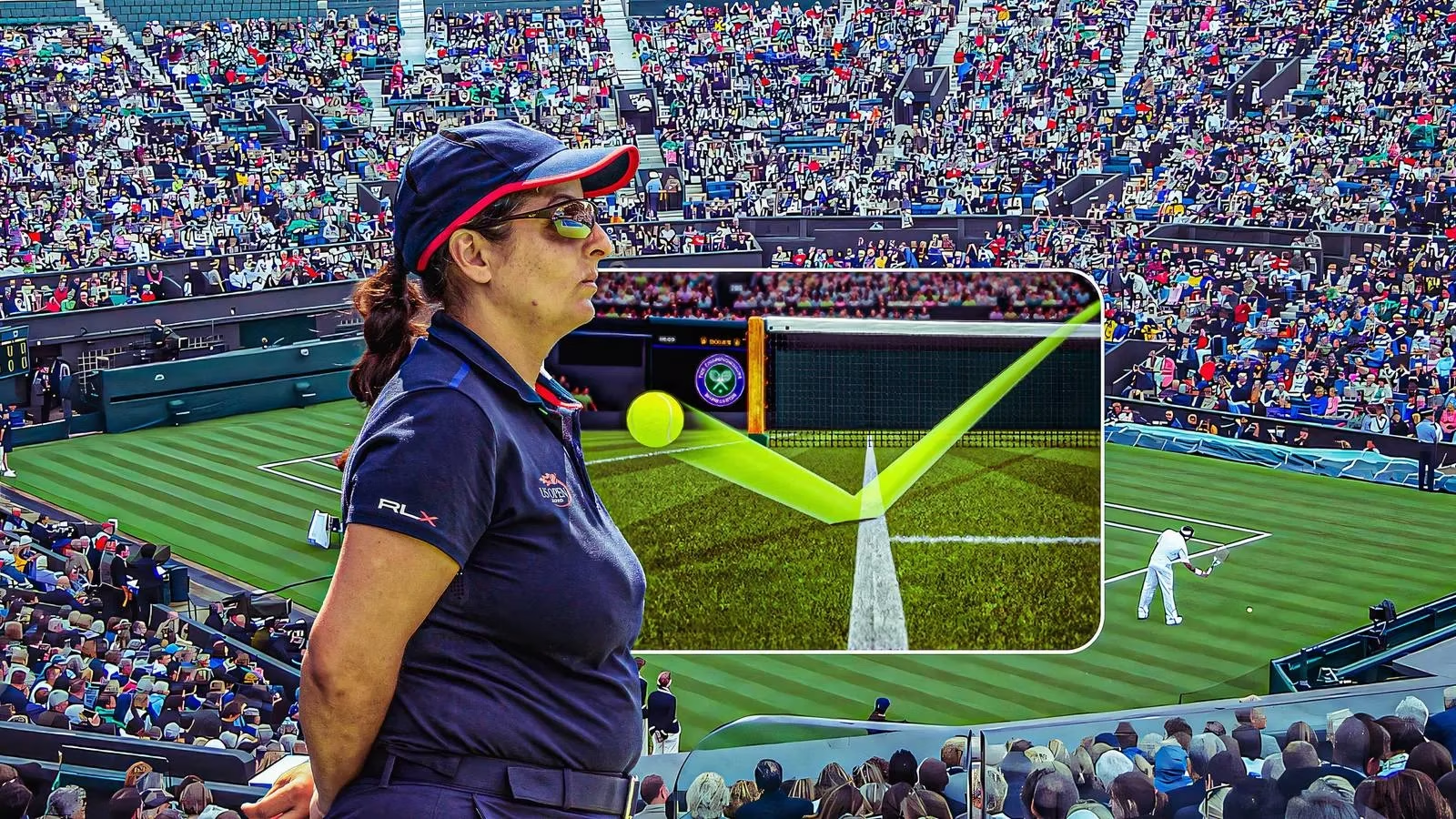
Back in October 2024, the All England Lawn Tennis Club announced that line judges would be removed after 148 years. I was not surprised, but I was a little emotional. Wimbledon has always been about tradition—the all-white clothing, the ivy, the strawberries and cream. Yet the sport has been moving toward automation for a while.
Live Electronic Line Calling, or Live ELC, is now used across the men’s ATP Tour and the women’s WTA Tour. It handles all line calls during rallies and also covers “fault” serves. At Wimbledon, the switch means roughly 300 line judges are no longer needed for their old roles. Instead, about 80 line judges will remain on site as match assistants whose job is to monitor the technology rather than make the calls themselves. I think that is a smart compromise: the human element does not disappear entirely, it just changes.
Sally Bolton, Chief Executive of the All England Club, explained the decision by saying the Club had been looking at the results of ball-tracking technology and felt it was time to take that next step. She also said the aim was to achieve maximum accuracy for players. That made sense to me—nobody likes losing a big point to a missed call.
The bigger context is that this is not really a radical experiment. The Australian Open removed human line judges in 2021, and the US Open followed in 2022. Hard-court tournaments have been using automated calls for several seasons now. Wimbledon took a little longer because of its history, but with most tour events already using an electronic system, the All England Club decided it was a no-brainer. I get it. When you train all year for the biggest moments, consistency in line calls matters.
That said, not every Grand Slam feels the same way. The French Open still uses line judges. Clay is different, of course—players and officials can look at ball marks left on the surface to determine whether a shot was in or out. There are also no player challenges at Roland-Garros. Gilles Morreton, president of the French Tennis Federation, said that human officials and line judges are still considered necessary at the event. I can appreciate both perspectives. Clay-court tennis has a tactile, physical element that hard courts and grass do not share, and the marks are part of that old-school charm.
For fans heading to SW19 or watching at home, the other major change is the final weekend schedule. This one might actually affect your plans more than the line calling. Instead of starting the singles finals directly at 2pm, the provisional schedule places a doubles final on Centre Court first.
Here is the updated Centre Court flow:
| Day | Centre Court Start | Singles Final Follows | Approx Singles Start |
|---|---|---|---|
| Saturday | 1pm | Men’s doubles final | Around 4pm |
| Sunday | 1pm | Ladies’ doubles final | Around 4pm |
On Saturday, the ladies’ singles final follows the men’s doubles final. On Sunday, the men’s singles final follows the ladies’ doubles final. Both singles finals are therefore expected to begin at approximately 4pm. Before this provisional schedule, both singles finals traditionally started at 2pm, so this is a noticeable shift. I actually like it—it gives the doubles champions their own moment on Centre Court and builds the afternoon up nicely. But if you are buying tickets or planning your day, remember that a 1pm start no longer means a singles final is about to begin.
The draw also remains a huge moment. It is usually made on the Friday before play begins, and there are 128 players in each singles draw, including 32 seeded players, 16 qualifiers and eight wildcards. I always feel that those numbers hide some dangerous unseeded players, especially on grass, where a big serve and aggressive return can trouble almost anyone.
One thing I keep thinking about is how quickly this change went from rumour to reality. We spent years debating whether technology should replace humans on court. Now, for most of the season, players and fans barely mention it because the calls are just there. The emotion of a missed call has been replaced by the calm certainty of an automated voice. For a player like me, that consistency is valuable. You can trust that a ball landing on the edge will be called the same way in the first game and the final game.
Of course, I still love the theatre of Wimbledon. The grass, the white kit, the royal box—it is all still there. The line judges may be gone from their old positions, but the tournament has kept the parts that make it special. The new final weekend schedule means we get more tennis before the biggest trophies are lifted, and the electronic system means fewer arguments about whether a ball was out by a millimetre.
As we look ahead to this summer, I am genuinely curious how the schedule feels over a full fortnight. The doubles-first format is still new enough that viewers are adjusting. But if last season taught us anything, it is that Wimbledon can modernise without losing its soul. I will be watching, and honestly, I will not miss the close-up replays of line judges making mistakes—I will just be looking forward to the tennis.
Loading comments...